
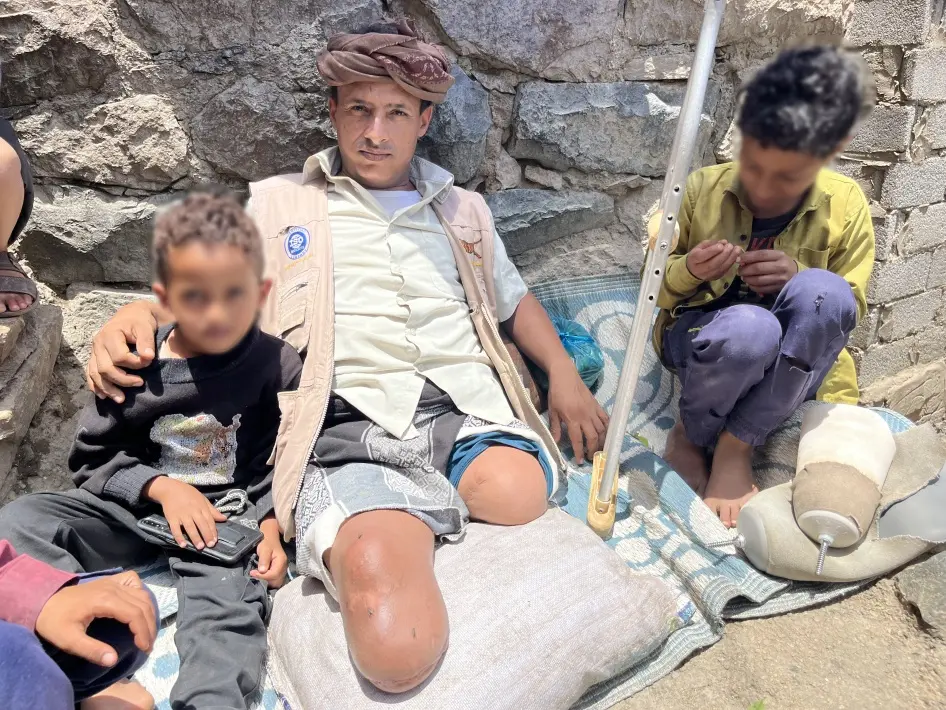
On the International Day for Mine Awareness, observed today, Saturday, April 4, the American Center for Justice (ACJ) affirms that landmine networks in Yemen constitute a parallel infrastructure of violence, continuing to claim lives and destroy livelihoods independently of the immediate military context that produced them.
The Center recalls its human rights report, “Mines.. Blind Killer,” which documented the systematic and indiscriminate planting of lethal devices across Yemeni territory. It notes that estimates based on field monitoring indicate more than fifteen thousand civilian victims, nearly 80 percent of whom suffer permanent disabilities and lifelong physical deformities as a result of the deliberate use of fragmentation devices and camouflaged explosives specifically designed to mimic the natural environment.
The Center further affirms that the Houthi militia bears full and exclusive responsibility for the planting of anti-personnel and anti-vehicle mines, as well as improvised and disguised explosive devices, in the current conflict. It emphasizes that the group’s failure, as a de facto actor, to accede to international treaties does not absolve it of criminal responsibility. Customary international humanitarian law imposes binding obligations prohibiting the use of indiscriminate weapons and the targeting of civilians, and places responsible leadership under potential prosecution under the principle of universal jurisdiction.
The Center underscores that landmines bear no legitimate relation to the principle of military necessity; rather, they operate as inherently indiscriminate and automated means of harm that kill civilians arbitrarily, without any threat posed by the victims. The brutality of this practice was starkly evident during the truce in mid-2022, when the cessation of hostilities prompted thousands of displaced persons to return to their villages and farms, only to encounter minefields laid by the Houthi militia prior to withdrawal. This resulted in severe human and material losses that undermined prospects for restoring normal life.
The Center also draws attention to an additional catastrophe resulting from the continued closure of main roads, particularly the Sana’a–Marib route, which forces travelers to take an alternative desert route through Al-Jawf Governorate. The danger along this compulsory route is exacerbated by climate change and flooding, which displace landmines and conceal them beneath shifting sand dunes, creating mobile and unpredictable death traps that expand the scope of the threat.
Recommendations:
The American Center for Justice also expresses its deep appreciation for the exceptional efforts undertaken by the Saudi “Masam” Project to clear Yemeni land of landmines, and commends the significant sacrifices made by its field teams in dismantling this deadly infrastructure, protecting civilian lives, and restoring safety.
The American Center for Justice calls on all relevant parties to fulfill their obligations through the following measures:
The international community and sponsors of peace processes: Require the handover of minefield maps as a preliminary condition prior to any political or security negotiations, and reject the marginalization of this crime in peace discussions.
The Houthi militia: Immediately cease the planting of all types of landmines, provide accurate maps of contaminated areas, and assume full criminal and material responsibility for ongoing violations against civilians.
The Yemeni government: Intensify efforts to provide sustainable medical and psychological care to victims, and integrate amputees into structured, long-term rehabilitation programs that go beyond temporary response measures.
International human rights organizations: Develop international litigation cases based on the principle of universal jurisdiction to hold accountable the military and political leaders involved in orchestrating this systematic mine-laying campaign.
American Center for Justice (ACJ)
April 4, 2026

Leave a Reply