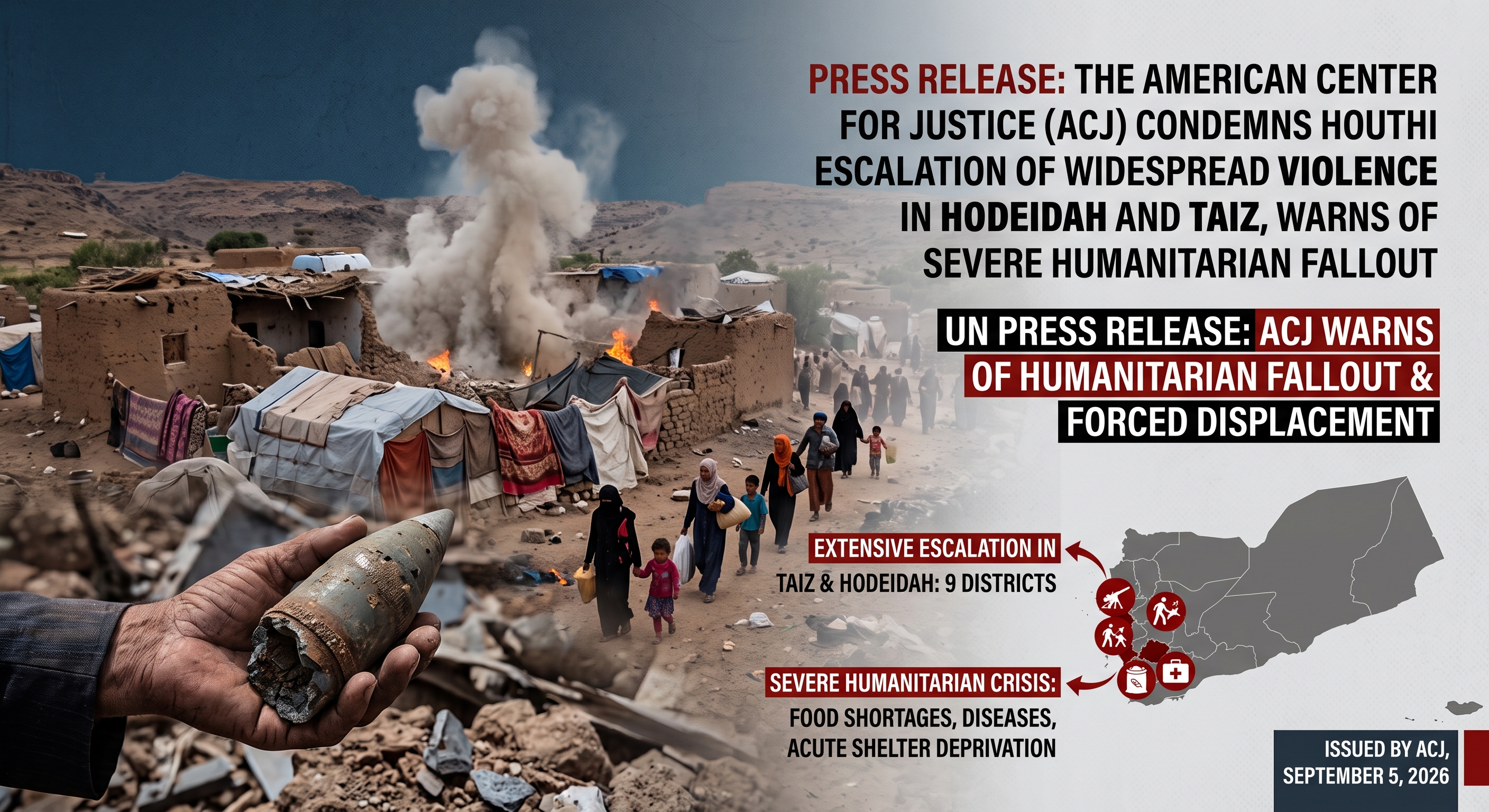
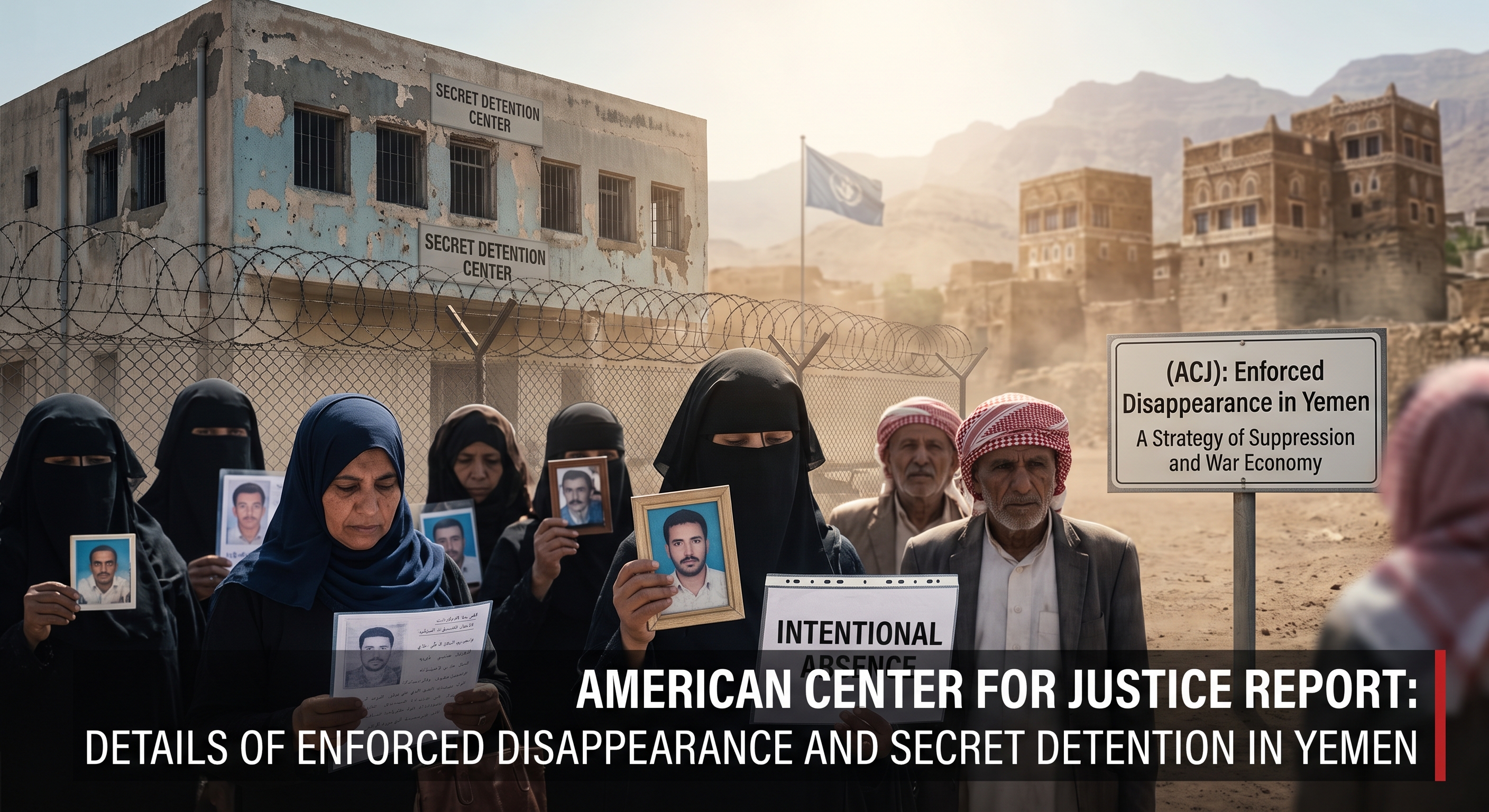
Tag: Houthis

  • American Center for Justice Condemns Houthi Reneging on Prisoner-Exchange Agreement and Warns of Undermining Peace Efforts

    American Center for Justice Condemns Houthi Reneging on Prisoner-Exchange Agreement and Warns of Undermining Peace Efforts

    The American Center for Justice (ACJ) strongly condemned the Houthi group’s withdrawal from its commitments under the Amman understandings concerning the exchange of prisoners and abductees. The Center described the move as a violation of de-escalation efforts and a deliberate exploitation of humanitarian issues to achieve political gains at the expense of the suffering of civilians and arbitrarily detained persons.

    In a statement, the Center said it had received urgent appeals for assistance from the families of abductees, indicating that the group was seeking to derail the United Nations-sponsored agreement. It noted that reneging on these commitments prolongs periods of detention, exposes detainees to physical and psychological violations in detention facilities that fail to meet even minimum humanitarian standards, and compounds the uncertainty and anxiety experienced by their families.

    The statement stressed that the detention of civilians and the use of their cases as bargaining tools violate fundamental principles of international humanitarian law and international human rights law, and deprive individuals of their right to liberty and security of person, as guaranteed by the Universal Declaration of Human Rights and international human rights instruments. It further emphasized that using this issue as a tool of political pressure constitutes a form of extortion prohibited under international law, while the continued practice of enforced disappearance and torture constitutes serious violations requiring those responsible to be held criminally accountable.

    The Center warned of the serious repercussions of this reversal on peacebuilding efforts in Yemen, stating that it undermines the credibility of United Nations mediation efforts and allows the Houthi group to continue disregarding international conventions and obligations. It added that exploiting the suffering of prisoners deepens social wounds, prolongs the conflict, and leaves victims’ families vulnerable to ongoing psychological and financial exploitation.

    The American Center for Justice (ACJ) called on the international community and the United Nations Special Envoy for Yemen to take concrete action and exert meaningful pressure to compel the group to fulfill its commitments under the Amman understandings without preconditions. It also called on international bodies to intensify their monitoring and documentation of violations committed against abductees and to pursue available legal avenues to ensure that perpetrators are held accountable and do not enjoy impunity.

    Full Statement

    Statement on the Houthi Group’s Delays in Implementing the Amman Agreement on the Exchange of Prisoners and Abductees

    The American Center for Justice (ACJ) strongly condemns the Houthi group’s withdrawal from its commitments under the understandings reached in Amman, the capital of Jordan, concerning the exchange of prisoners and abductees.

    This reversal constitutes a flagrant violation of de-escalation efforts and reveals the deliberate exploitation and instrumentalization of humanitarian issues to achieve political gains at the expense of the suffering of civilians and arbitrarily detained persons.

    The Center has received urgent appeals for assistance from the families of abductees indicating that the Houthi group is obstructing the implementation of the United Nations-sponsored agreement, under which the parties committed to ending the suffering of thousands of detainees and facilitating their return to their families. This repudiation prolongs periods of detention, exposes detainees to further physical and psychological violations in detention facilities that fail to meet even minimum humanitarian standards, and compounds the suffering of families living in a state of constant uncertainty and anxiety regarding the fate of their loved ones.

    The detention of civilians and the use of their cases as bargaining tools violate fundamental principles of international humanitarian law and international human rights law. These practices deprive individuals of their right to liberty and security of person, as guaranteed under the Universal Declaration of Human Rights and the International Covenant on Civil and Political Rights.

    The use of the issue of abductees as a tool of political pressure constitutes a form of extortion prohibited under international law. The continued practice of enforced disappearance and torture also constitutes serious violations requiring criminal accountability for those responsible.

    Reneging on humanitarian agreements has serious repercussions for peacebuilding efforts in Yemen. It undermines the credibility of United Nations mediation efforts, while the absence of decisive international action allows the Houthi group to continue disregarding international conventions and obligations and places the international system before a moral and legal responsibility to protect civilians.

    The exploitation of the suffering of prisoners deepens social wounds, prolongs the conflict, and leaves victims’ families vulnerable to ongoing psychological and financial exploitation.

    The Center urgently calls on the international community and the United Nations Special Envoy for Yemen to take concrete action and exert meaningful pressure to compel the Houthi group to fulfill its commitments under the Amman understandings without preconditions.

    The Center further emphasizes the need for international bodies to intensify their monitoring and documentation of violations committed against abductees and to pursue available legal avenues to ensure that perpetrators are held accountable and do not enjoy impunity.

    The Center calls for the humanitarian issue concerning prisoners and abductees to be separated from all political bargaining and for coordinated action to end, without delay, the suffering of all detainees and their families, in accordance with the principles of justice and equity.

    Issued by the American Center for Justice (ACJ)
    3 August 2026

  • American Center for Justice: Denial of Vaccines in Yemen Endangers 600,000 Children and May Constitute a War Crime

    American Center for Justice: Denial of Vaccines in Yemen Endangers 600,000 Children and May Constitute a War Crime

    The American Center for Justice (ACJ) condemned policies that deprive hundreds of thousands of children in Yemen of healthcare and immunization, rejecting the use of vaccines and medical supplies as instruments of political pressure or collective punishment in the context of the armed conflict.

    The Center stated that Yemen’s health crisis is worsening as a result of decisions that prevent comprehensive door-to-door vaccination campaigns, particularly in densely populated governorates under the control of the Houthi group. According to the Center, these policies, together with disinformation campaigns targeting vaccines, have left approximately 600,000 children without immunization. This figure represents 35 percent of all children who have not received vaccinations across the Middle East and North Africa region, while vaccination coverage for polio, measles, and diphtheria has fallen below 50 percent.

    The statement noted that more than 80 percent of children infected with measles had not received a single vaccine dose, while Yemen reportedly loses more than 100 children every day to preventable diseases. The Center warned that the situation could amount to a long-term process of destruction.

    The Center stated that this deprivation is incompatible with international humanitarian law and international criminal law. It cited Article 54 of Additional Protocol I and Article 14 of Additional Protocol II, which prohibit the starvation of civilians and the deprivation of objects indispensable to their survival. The Center also referred to the obligations set out in Article 12 of the International Covenant on Economic, Social and Cultural Rights and Article 24 of the Convention on the Rights of the Child.

    The Center stressed that the deliberate obstruction of access to medical supplies may constitute a war crime and may give rise to individual criminal responsibility under Article 8 of the Rome Statute of the International Criminal Court. It further stated that such conduct may amount to crimes against humanity where it is intended to subject populations to living conditions calculated to bring about the destruction of part of the population.

    The statement also highlighted the economic and demographic consequences of the crisis. The resurgence of epidemics such as polio may result in permanent disabilities that exclude thousands of people from the future workforce, push families into poverty, and force them to liquidate productive assets to meet emergency medical costs. According to the Center, these consequences erode human capital and divert limited resources toward emergency responses to human-made crises.

    The American Center for Justice called on the international community and United Nations agencies to intervene urgently to end the medical blockade, insulate the health sector from political and military considerations, and ensure that vaccination teams can operate without restrictions. The Center also called on international commissions of inquiry and the Office of the Prosecutor of the International Criminal Court to document these alleged violations and develop legal case files identifying the potential individual criminal responsibility of leaders implicated in restricting vaccination efforts. It further urged states exercising universal jurisdiction to initiate legal proceedings against those responsible for depriving civilians of healthcare and to ensure that they do not evade accountability.

    Statement on the Deprivation of Children of Vaccines and the Spread of Epidemics in Yemen

    The American Center for Justice (ACJ) unequivocally condemns the systematic policies that deprive hundreds of thousands of children in Yemen of their fundamental right to healthcare and immunization. The Center also rejects the use of vaccines and health supplies as instruments of political pressure or collective punishment in the context of the armed conflict.

    Yemen’s health crisis is worsening as a result of deliberate decisions that prevent comprehensive door-to-door vaccination campaigns, particularly in densely populated governorates under the control of the Houthi group.

    The number of children deprived of immunization is approaching 600,000, equivalent to 35 percent of all children who have not received vaccines across the Middle East and North Africa region. These restrictive policies are accompanied by organized disinformation campaigns aimed at undermining confidence in vaccines and have contributed to vaccination coverage for polio, measles, and diphtheria falling below 50 percent.

    Available statistics indicate that more than 80 percent of children infected with measles had not received a single vaccine dose. Yemen reportedly loses more than 100 children every day to preventable diseases, making the situation akin to a long-term process of destruction.

    The Center maintains that this deliberate deprivation constitutes a grave violation of international humanitarian law and international criminal law. Article 54 of Additional Protocol I and Article 14 of Additional Protocol II prohibit the starvation of civilians and the deprivation of objects indispensable to their survival.

    The Center further maintains that the deliberate obstruction of medical supplies from reaching civilians constitutes a war crime giving rise to individual criminal responsibility under Article 8 of the Rome Statute of the International Criminal Court. It adds that such conduct may amount to crimes against humanity where populations are subjected to harsh living conditions intended to bring about the destruction of part of the population.

    This denial violates the core obligations set out in Article 12 of the International Covenant on Economic, Social and Cultural Rights and Article 24 of the Convention on the Rights of the Child, which require all parties to protect children from disease and provide comprehensive immunization programmes.

    The impact of these policies extends beyond a public health setback. It undermines the foundations of the local economy and affects the demographic structure of Yemeni society, both now and in the future. The resurgence of deadly epidemics such as polio may result in permanent disabilities that exclude thousands of people from future economic participation, increase poverty and dependency, and force families to liquidate productive assets to meet emergency medical costs.

    These pressures deepen poverty, divert resources away from development projects and the improvement of essential services, erode human capital, which is the principal driver of societal recovery, and trap scarce financial resources in emergency responses to human-made crises.

    The American Center for Justice (ACJ) calls on the international community and United Nations agencies to intervene immediately to end the medical blockade imposed on children in Yemen. The Center emphasizes the need to insulate health-related issues from political and military considerations and to guarantee unhindered access for vaccination teams to reach all households without restriction.

    The Center calls on international commissions of inquiry and independent United Nations mechanisms to document these alleged violations and develop comprehensive legal case files identifying the potential individual criminal responsibility of leaders who issue decisions restricting vaccination campaigns or incite opposition to vaccines. The Center also urges the Office of the Prosecutor of the International Criminal Court to receive communications concerning these alleged crimes.

    The Center appeals to states that apply the principle of universal jurisdiction to initiate legal proceedings and pursue those implicated in depriving Yemeni civilians of essential healthcare. It calls for measures to ensure that those responsible do not evade accountability and to protect future generations from gradual destruction.

    Issued by the American Center for Justice (ACJ)
    July 30, 2026

  • Lawyers Under Attack by Authorities: Iran Arrests and Tortures, Tunisia Imprisons, and the Houthis Kidnap

    Lawyers Under Attack by Authorities: Iran Arrests and Tortures, Tunisia Imprisons, and the Houthis Kidnap

    The American Center for Justice (ACJ) expresses its deep concern over the escalating campaign of systematic repression targeting lawyers and judges across the Middle East and North Africa. This statement highlights three serious cases that reveal a consistent pattern of state authorities using their authority as a tool to suppress the independent defence of human rights.

    On 1 April 2026, officers from Iran’s Ministry of Intelligence raided the home of prominent human rights lawyer Nasrin Sotoudeh in Tehran, arrested her for the fifth time, and confiscated her electronic devices. During her detention, she was reportedly subjected to serious human rights violations, including beatings, the shackling of her hands and feet, and detention in inhumane conditions, as documented by Front Line Defenders. She was released on bail on 13 May 2026 after being charged with “propaganda against the state” in connection with her public statements concerning the government’s repression and Iran’s nuclear programme.

    Sotoudeh’s case is not an isolated incident. According to documentation by the Center for Human Rights in Iran (CHRI), at least 32 lawyers were arrested, brought before the courts, or imprisoned between January and June 2026. Documented cases include the arrest of lawyer Elham Zeraatpisheh, who was later sentenced to six years’ imprisonment, along with the confiscation of her passport; the arrest and enforced disappearance of lawyer Setareh Ansari in Fars Province in May 2026; and the sentencing of lawyer Javad Alikordi to eighteen years’ imprisonment.

    These patterns amount to a systematic assault on the independence of lawyers in Iran, in violation of Articles 9 and 14 of the International Covenant on Civil and Political Rights (ICCPR), as well as Principle 16 of the United Nations Basic Principles on the Role of Lawyers.

    In Tunisia, on 6 April 2026, the Tunis Court of Appeal sentenced Judge Anas Hamdi, President of the Tunisian Judges Association, to one year’s imprisonment on charges of “obstructing the freedom to work” under Article 136 of the Tunisian Penal Code. The charges stemmed from his role in the 2022 judges’ strike, which was organised in defence of judicial independence in response to presidential decrees dismissing fifty-seven judges. Hamdi had previously represented the dismissed judges in legal proceedings, which appears to have been the actual motive behind his prosecution.

    Three United Nations Special Rapporteurs explicitly expressed their “grave concern” over the case, stating that the conviction targets legitimate trade union activity. The case forms part of a broader pattern of repression affecting hundreds of opposition figures, lawyers, and civil society members in Tunisia. According to Amnesty International and Human Rights Watch, at least eight lawyers are currently serving prison sentences, including the former President of the Tunisian Bar Association.

    This conviction constitutes a clear violation of Article 22 of the International Covenant on Civil and Political Rights (ICCPR), which guarantees the right to freedom of association, including the right to form and join trade unions, as well as the United Nations Basic Principles on the Independence of the Judiciary.

    In Yemen, the Houthi de facto authorities continue to arbitrarily detain human rights lawyer Abdulmajeed Sabra, who has been held since 25 September 2025. On that date, Houthi militia forces raided his law office in the Shumaila district of Sana’a and abducted him without a judicial warrant. Sabra has remained in detention for more than nine months in facilities operated by the Houthi Security and Intelligence Service in the Sarf area, north of Sana’a, without being formally charged or brought before a judicial authority.

    In protest against his continued unlawful detention, Sabra undertook a hunger strike. While in custody, the Houthi authorities demanded that he abandon his human rights work, cease representing detainees, and refrain from publishing political views in exchange for his release. Despite his coerced acceptance of these conditions, they failed to honour their commitment to release him. Furthermore, Sabra’s brother documented that Houthi personnel threatened family members who had publicly advocated for his release on social media with arrest.

    Sabra is one of Yemen’s leading advocates for the rights of individuals detained in Houthi prisons. His continued detention constitutes a clear violation of Article 9 of the International Covenant on Civil and Political Rights (ICCPR), which prohibits arbitrary detention, as well as the provisions of international humanitarian law protecting civilians.

    A United Nations communication issued by five Special Rapporteurs and Working Groups of the UN Human Rights Council called for the direct legal accountability of the Houthi de facto authorities, in their capacity as the de facto authorities in Sana’a, for the arbitrary detention and enforced disappearance of the prominent human rights lawyer Abdulmajeed Sabra.

    These three cases demonstrate that the targeting of lawyers and judges is not the result of isolated incidents but reflects a systematic policy. The authorities in Iran, Tunisia, and Houthi-controlled areas of Yemen are criminalising legitimate legal work and using it as a pretext to silence independent voices and render the guarantees of a fair trial meaningless.

    The American Center for Justice (ACJ) calls for:

    • The withdrawal of all charges against human rights lawyer Nasrin Sotoudeh and all lawyers detained in Iran in connection with their legitimate human rights work, as well as the establishment of an independent investigation into allegations of torture and other forms of ill-treatment.
      • The immediate and unconditional release of human rights lawyer Abdulmajeed Sabra and all individuals arbitrarily detained in Houthi-controlled areas of Yemen.
    • The annulment of the conviction against Judge Anas Hamdi and an end to the judicial proceedings targeting lawyers and judges in Tunisia on the basis of their legitimate trade union activities.
    • The United Nations Human Rights Council and the Office of the United Nations High Commissioner for Human Rights (OHCHR) to issue clear and public statements addressing these cases.

    American Center for Justice (ACJ).

  • Arbitrary Detention and Enforced Disappearance of a Citizen in Sana’a Over His Religious Advocacy Activities

    Arbitrary Detention and Enforced Disappearance of a Citizen in Sana’a Over His Religious Advocacy Activities

    Eyewitnesses informed the American Center for Justice (ACJ) that a security force affiliated with the Houthi group arrested the citizen “Ayman Dhabyan Mohammed” in front of a mosque in the Airport area of the capital, Sana’a, while he was on his way to perform Maghrib prayer, and took him to an undisclosed location.

    Dhabyan works operating a mobile ice cream cart. According to testimonies, the force, using a military vehicle and official uniforms, carried out the arrest without presenting any legal justification or arrest warrant issued by the public prosecutor’s office. The detainee is currently being subjected to enforced disappearance, as local police stations in the area have denied responsibility for his detention and have provided conflicting information to his family regarding his whereabouts, shifting responsibility between the district administration and the intelligence apparatus.

    Dhabyan is known for his voluntary religious outreach activities, including delivering sermons and religious lessons within his local community. His arrest comes within a broader context aimed at suppressing independent social actors, monopolizing public space, and preventing any religious or guidance activities that are not under the group’s supervision and control.

    The American Center for Justice emphasizes that these practices constitute a blatant violation of the right to personal liberty and security, and an infringement on freedom of belief and expression. The Center calls for the immediate disclosure of Ayman Dhubyan’s fate and his unconditional release, holding the Houthi-affiliated security authorities legally and criminally responsible for his safety and life.

  • Statement: The American Center for Justice (ACJ) Calls for an End to Systematic Repression Against Journalists in Yemen

    Statement: The American Center for Justice (ACJ) Calls for an End to Systematic Repression Against Journalists in Yemen

    On the occasion of World Press Freedom Day, 3 May, the Yemeni media community continues to face targeted violations that strike at the core of the profession and the safety of those who practice it. Journalism in Yemen has increasingly become a high-risk endeavor, placing practitioners in direct confrontation with repressive authorities whose names may differ, but whose practices converge in the silencing of free expression.

    Houthi Detention Facilities: Medical Neglect as a Form of Abuse
    The American Center for Justice (ACJ) expresses deep concern over the severe deterioration in the health condition of journalist Adel Al-Siyaghi, who is detained by the Houthi group in Sana’a. Al-Siyaghi is reportedly suffering from extensive skin ulcers and is being deliberately denied access to basic medical care.

    The Center considers the deliberate denial of medical treatment to a detainee as a form of systematic ill-treatment that may amount to torture, aimed at undermining the physical and psychological integrity of detainees. The group bears full legal and moral responsibility for the life and well-being of Al-Siyaghi, as well as all detained journalists under its control, each of whom represents a prolonged story of suffering.

    Aden: Undermining the Rule of Law and Arbitrary Detention
    In the interim capital, Aden, another pattern of violations is evident in the continued detention of journalist Naseh Shaker, despite a judicial order mandating his release.

    Failure to implement court rulings undermines the authority and effectiveness of the judiciary and reflects the dominance of security actors operating beyond constitutional oversight. This conduct constitutes a clear case of arbitrary detention and requires immediate compliance with the rule of law and accountability.

    Demands and Calls for Action
    Ensuring the protection of journalism in Yemen requires the international community to move beyond rhetorical condemnation toward concrete measures that guarantee the safety and rights of journalists. Accordingly, the American Center for Justice calls for:

    •⁠ ⁠Immediate Release: The unconditional release of all detained journalists across all Yemeni governorates.

    •⁠ ⁠Urgent Medical Intervention: Allowing medical missions and international organizations to access Adel Al-Siyaghi and provide him with immediate and necessary treatment.

    •⁠ ⁠Respect for the Rule of Law: The prompt enforcement of judicial decisions ordering the release of Naseh Shaker, and an end to the overreach of security bodies over judicial authority.

    •⁠ ⁠International Accountability: Prioritizing violations against journalists in Yemen within international investigative mechanisms to ensure accountability and prevent impunity.

    The American Center for Justice affirms that the resilience of Yemeni journalists in the face of these challenges remains a vital safeguard for truth. Standing in solidarity with their just causes is a legal and moral obligation that cannot be deferred.

  • Press Release: Sniping of Children in Taiz .. Systematic Houthi Exploitation of Civilian Vulnerability

    Press Release: Sniping of Children in Taiz .. Systematic Houthi Exploitation of Civilian Vulnerability

    The American Center for Justice (ACJ) unequivocally condemns the ongoing sniper attacks targeting civilians in the city of Taiz. The latest victim, 14-year-old Ibrahim Jalal Amin, was fatally shot by a Houthi-affiliated sniper positioned in the Al-Mawshaki area while returning home from school on April 5. This incident reflects a recurring pattern of conduct that deliberately targets individuals least able to protect themselves or respond to hostile fire.

    The deployment of precision sniper weapons equipped with advanced optics provides the perpetrator with clear visual identification of the victim, thereby eliminating any plausible claim of accidental or indiscriminate harm. The targeting of children and women in densely populated civilian areas constitutes a deliberate and calculated military practice aimed at crippling community life and engineering demographic displacement. By turning school routes and water collection points into zones of lethal risk, these actions impose gradual forced displacement, effectively transforming residential neighborhoods into depopulated buffer zones that facilitate military domination.

    Within this framework, the systematic targeting of economically and socially vulnerable populations represents a deliberate strategy to consolidate front lines at minimal operational cost. By focusing on families compelled by necessity to remain in high-risk areas and unable to afford displacement, perpetrators achieve localized deterrence while avoiding retaliatory dynamics that might arise from targeting members of armed groups or influential tribal networks. Consequently, these vulnerable populations are left exposed to sustained sniper threats, their daily existence reduced to a continuous mechanism of coercion, and their communities transformed into environments governed by entrenched fear.

    These field-based violations are compounded by a media discourse that deliberately obscures accountability by promoting misleading narratives about the political beneficiaries of condemning such crimes. This tactic seeks to detach the criminal act from its material reality, disregarding the fact that the gunfire originates from positions under the group’s control following deliberate identification of the victim. By shifting the discourse from the physical crime scene to speculative political interpretation, this narrative performs a dual function: concealing the direct perpetrator and fostering a climate of legal paralysis that enables ongoing violations and facilitates impunity.

    In light of these grave and ongoing abuses, the American Center for Justice stresses that routine international condemnations have failed to deter this pattern of violence and have contributed to the instrumentalization of vulnerable civilians as bargaining tools. ACJ therefore calls on the international community and the UN Special Envoy to adopt concrete and enforceable measures to halt this human attrition. These include lifting the siege on Taiz, ensuring the withdrawal of military positions overlooking civilian neighborhoods, and activating international accountability mechanisms through rigorous criminal documentation that links each violation to its direct perpetrator as well as the chain of command responsible for authorizing and sustaining such acts. These steps are essential to breaking the cycle of impunity and ensuring effective protection for civilian lives.

  • Press Release: Landmines in Yemen — A Sustainable Infrastructure of Violence and a Crime That Cannot Be Justified by Military Necessity

    Press Release: Landmines in Yemen — A Sustainable Infrastructure of Violence and a Crime That Cannot Be Justified by Military Necessity

    On the International Day for Mine Awareness, observed today, Saturday, April 4, the American Center for Justice (ACJ) affirms that landmine networks in Yemen constitute a parallel infrastructure of violence, continuing to claim lives and destroy livelihoods independently of the immediate military context that produced them.

    The Center recalls its human rights report, “Mines.. Blind Killer,” which documented the systematic and indiscriminate planting of lethal devices across Yemeni territory. It notes that estimates based on field monitoring indicate more than fifteen thousand civilian victims, nearly 80 percent of whom suffer permanent disabilities and lifelong physical deformities as a result of the deliberate use of fragmentation devices and camouflaged explosives specifically designed to mimic the natural environment.

    The Center further affirms that the Houthi militia bears full and exclusive responsibility for the planting of anti-personnel and anti-vehicle mines, as well as improvised and disguised explosive devices, in the current conflict. It emphasizes that the group’s failure, as a de facto actor, to accede to international treaties does not absolve it of criminal responsibility. Customary international humanitarian law imposes binding obligations prohibiting the use of indiscriminate weapons and the targeting of civilians, and places responsible leadership under potential prosecution under the principle of universal jurisdiction.

    The Center underscores that landmines bear no legitimate relation to the principle of military necessity; rather, they operate as inherently indiscriminate and automated means of harm that kill civilians arbitrarily, without any threat posed by the victims. The brutality of this practice was starkly evident during the truce in mid-2022, when the cessation of hostilities prompted thousands of displaced persons to return to their villages and farms, only to encounter minefields laid by the Houthi militia prior to withdrawal. This resulted in severe human and material losses that undermined prospects for restoring normal life.

    The Center also draws attention to an additional catastrophe resulting from the continued closure of main roads, particularly the Sana’a–Marib route, which forces travelers to take an alternative desert route through Al-Jawf Governorate. The danger along this compulsory route is exacerbated by climate change and flooding, which displace landmines and conceal them beneath shifting sand dunes, creating mobile and unpredictable death traps that expand the scope of the threat.

    Recommendations:

    The American Center for Justice also expresses its deep appreciation for the exceptional efforts undertaken by the Saudi “Masam” Project to clear Yemeni land of landmines, and commends the significant sacrifices made by its field teams in dismantling this deadly infrastructure, protecting civilian lives, and restoring safety.

    The American Center for Justice calls on all relevant parties to fulfill their obligations through the following measures:

    The international community and sponsors of peace processes: Require the handover of minefield maps as a preliminary condition prior to any political or security negotiations, and reject the marginalization of this crime in peace discussions.

    The Houthi militia: Immediately cease the planting of all types of landmines, provide accurate maps of contaminated areas, and assume full criminal and material responsibility for ongoing violations against civilians.

    The Yemeni government: Intensify efforts to provide sustainable medical and psychological care to victims, and integrate amputees into structured, long-term rehabilitation programs that go beyond temporary response measures.

    International human rights organizations: Develop international litigation cases based on the principle of universal jurisdiction to hold accountable the military and political leaders involved in orchestrating this systematic mine-laying campaign.

    American Center for Justice (ACJ)
    April 4, 2026

  • المركز الأمريكي للعدالة يدين احتجاز الوسيط المرادي ويطالب بإنقاذ ملف الأسرى

    المركز الأمريكي للعدالة يدين احتجاز الوسيط المرادي ويطالب بإنقاذ ملف الأسرى

    يعرب المركز الأمريكي للعدالة (ACJ) عن تفاجئه البالغ وإدانته الشديدة لقيام جماعة الحوثي باحتجاز الوسيط المحلي، الشيخ عبداللطيف المرادي، فور وصوله إلى العاصمة صنعاء استجابة لدعوة رسمية من “لجنة الأسرى” التابعة لها.
    إن استدراج وسيط بضمانات رسمية ثم تقييد حريته هو سلوك يضرب جذور الثقة التي تستند إليها أي مفاوضات، ويحيل الوسطاء إلى رهائن وأوراق ضغط تخضع للحسابات الأمنية، ويعيق جهودهم في حل العقد التقنية التي تمنع إنجاز صفقات التبادل، كما يعكس هذا الإجراء توجهاً يقصد تفكيك آليات الوساطة المحلية، ويفرّغ المسار الإنساني من الفاعلين المستقلين.
    يعيد هذا الاحتجاز التذكير بقضية المحامي عبدالمجيد صبرة، ليؤكد تمسك الجماعة بسياسة منهجية تستهدف ترهيب الفاعلين، وتجرف الساحة من المدافعين والوسطاء القادرين على إحداث اختراقات ملموسة في القضايا الإنسانية المعقدة.
    يطالب المركز جماعة الحوثي بالتوقف الفوري عن هذه السياسة التدميرية التي تحتكر مساحات التفاوض وتقطع قنوات التواصل المجتمعية، ويدعو إلى الإفراج العاجل عن المرادي، والسماح لملف الأسرى والمختطفين بالتحرك الإيجابي بعيداً عن تكتيكات الاستحواذ والترهيب.
    ويحذر المركز من أن الإصرار على استهداف القنوات المستقلة يغلق منافذ الحل المتبقية، ويعطل مسار التبادل، ويضاعف أمد المعاناة القاسية التي تتكبدها آلاف العائلات اليمنية.
    المركز الأمريكي للعدالة (ACJ)
    25 مارس 2026

  • بيان إدانة صادر عن المركز الأمريكي للعدالة (ACJ) بشأن القصف الصاروخي الذي شنته جماعة الحوثي على مديرية حيران في محافظة حجة

    بيان إدانة صادر عن المركز الأمريكي للعدالة (ACJ) بشأن القصف الصاروخي الذي شنته جماعة الحوثي على مديرية حيران في محافظة حجة

    بيان إدانة صادر عن المركز الأمريكي للعدالة (ACJ) يدين المركز الأمريكي للعدالة القصف الصاروخي الذي شنته جماعة الحوثي على مديرية حيران في محافظة حجة، يوم الأحد 15 مارس 2026 الموافق 26 رمضان.

    استهدف القصف منزل المواطن عادل الجنيد أثناء تجمع المدنيين لتناول طعام الإفطار، وأسفر عن سقوط عشرات الضحايا من المدنيين العزل. تشير المعلومات والتقارير الأولية إلى أن عدد القتلى تجاوز 15 شخصاً، بينما زاد عدد الجرحى عن 20، مايعني ارتفاع إجمالي الضحايا عن أكثر من 30 مدنيا.

    المعلومات المتوفرة حتى الان تؤكد مقتل ثمانية مدنيين على الأقل، بينهم طفلين هما: مودة أكرم الشاوش (3 سنوات) وعبدالرحمن مصعب الطيب (5 سنوات)، إلى جانب ستة بالغين. كما أصاب القصف مدنيين آخرين، بينهم الطفلة أسماء مصعب الطيب، التي تبلغ من العمر ثلاث سنوات، وطارق عادل جنيد، الذي لم يتجاوز الثانية من العمر.

    يمثل توجيه نيران المدفعية نحو منزل مدني، وفي وقت تتجمع فيه العائلات للإفطار، انتهاكاً جسيماً لمبادئ وأحكام الشريعة الإسلامية، وخرقا لقواعد القانون الدولي الإنساني. تعكس هذه الهجمات استخفافاً ممنهجاً بحياة المدنيين، وتؤكد أن استمرار قصف الأماكن المأهولة بالسكان يجرد النزاع من أي التزامات قانونية أو أخلاقية، ويعمق فداحة الكلفة الإنسانية في اليمن.

    يدعو المركز المجتمع الدولي والآليات الأممية المعنية بحقوق الإنسان إلى التدخل وتوثيق هذه الانتهاكات، والتحرك الجاد لضمان مساءلة مرتكبيها حيث تتطلب حماية المدنيين تدابير عملية توقف هذه الهجمات، وتضع حداً لحالة الإفلات المستمر من العقاب.

    صادر عن المركز الأمريكي للعدالة ACJ 15 مارس 2026

    • الصورة لأبناء القرى في حيران حسب عاداتهم حيث يجتمع سكان القريه في إفطار جماعي.
    الصورة لأبناء القرى في حيران حسب عاداتهم حيث يجتمع سكان القريه في إفطار جماعي.
  • Five special rapporteurs of the Human Rights Council issue a joint memorandum regarding the Houthi arrest of lawyer Abdulmajid Sabra.

    Five special rapporteurs of the Human Rights Council issue a joint memorandum regarding the Houthi arrest of lawyer Abdulmajid Sabra.

    The American Center for Justice welcomes the memorandum issued by five UN Special Rapporteurs and Working Groups of the Human Rights Council and supports its call for direct legal accountability for the Ansar Allah movement, as the de facto authority in Sana’a, regarding the arbitrary arrest and enforced disappearance of lawyer and human rights defender Abdulmajid Sabra.

    The Center notes the gravity of the facts documented by the Special Rapporteurs. On September 25, 2025, Houthi security and intelligence personnel stormed Sabra’s office and arrested him because of a Facebook post in which he criticized the authorities’ restrictions on citizens’ right to commemorate the anniversary of the September 26 Revolution. The Center draws attention to the significance of the UN memorandum’s inclusion of the “cultural courses” mechanism, deeming it a repressive tool employed by security agencies for weeks or months to reshape the ideological convictions of political detainees. This mechanism is often accompanied by solitary confinement to break their will.

    The Center endorses the legal basis adopted in the UN document, which obligates the Houthi movement to implement Common Article 3 of the Geneva Conventions and international human rights law. The Center agrees with the UN experts that the lack of international recognition of the de facto authority does not absolve it of the responsibility to guarantee the rights of individuals under its control. The isolation of lawyer Sabra and the lack of any information about him constitute a violation of peremptory norms of international law prohibiting enforced disappearance.

    The American Center for Justice emphasizes the memorandum’s warning regarding the undermining of the legal protection system. It considers the targeting of a human rights lawyer who has defended victims of enforced disappearance a violation of the UN’s fundamental principles concerning the role of lawyers. This targeting aims to deprive society of its legal defense by intimidating human rights defenders and preventing them from carrying out their duties with immunity and independence.

    The Center joins the demands of UN experts for the immediate disclosure of the whereabouts of lawyer Sabra, clarification of the legal basis for his arrest, and guarantees of his physical safety and right to a fair trial. It also calls for an end to the security agencies’ use of this mechanism to criminalize freedom of expression and monopolize public space.