
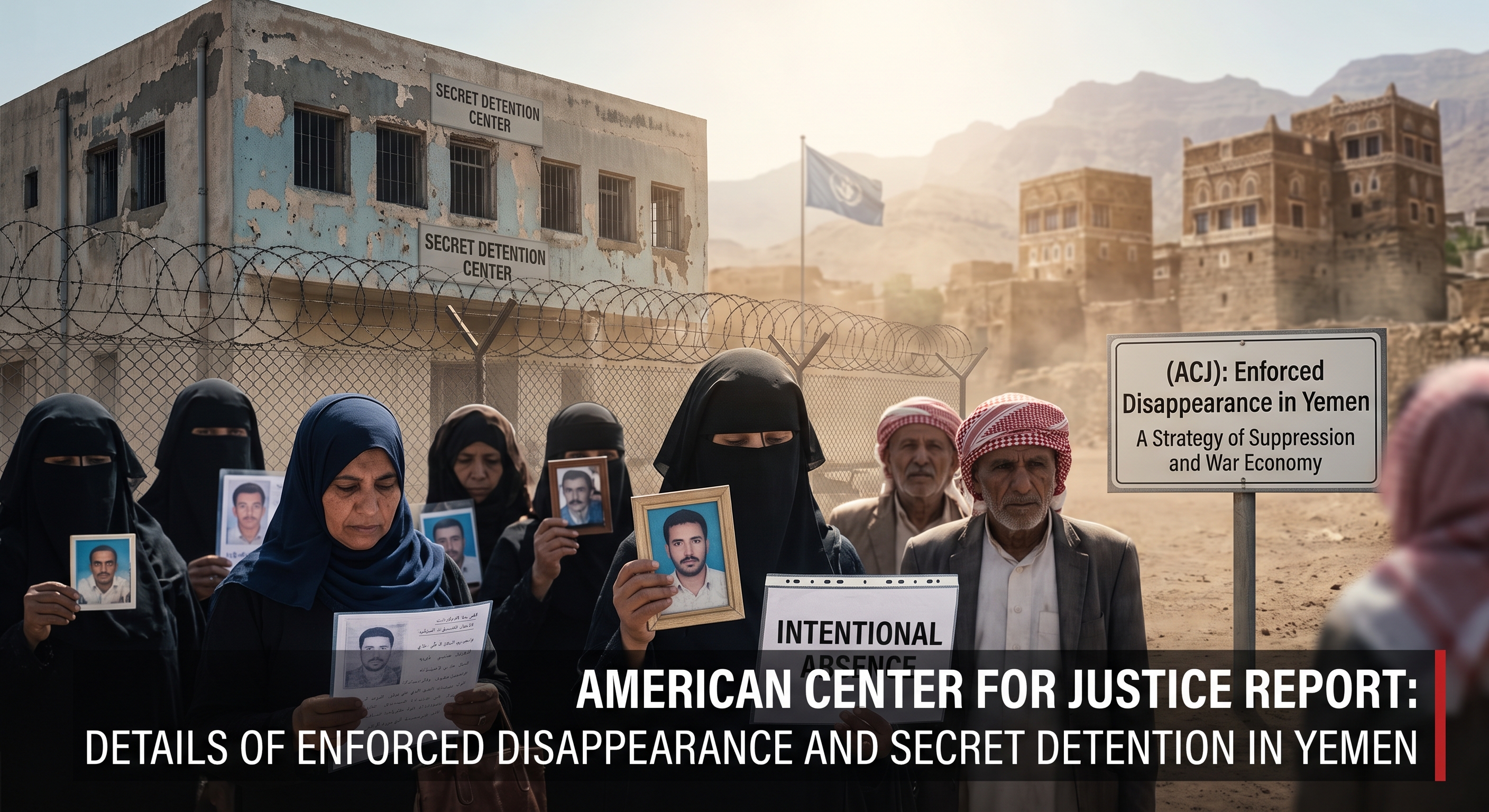
American Center for Justice Launches “A Deliberate Absence” Study:
Enforced Disappearance in Yemen: A Systematic Strategy of Repression and a Revenue Stream for the War Economy
The American Center for Justice (ACJ) has launched its comprehensive human rights and investigative study entitled “A Deliberate Absence: The Strategy of Enforced Disappearance and the Networks of Secret Detention Centers in Yemen.” The study examines and deconstructs the practices of enforced disappearance and the networks of unofficial detention facilities operated by the parties to the conflict. It reveals the transformation of enforced disappearance from an occasional security measure into a deliberate policy aimed at subjugating society and removing civil and political actors from public life, while simultaneously transforming it into a source of revenue that sustains extortion networks affiliated with the war economy. These networks demand exorbitant sums from victims’ families in exchange for preliminary information or false promises of release.
The study provides a geographical map of secret detention centers and documents the seizure by armed formations of vital civilian facilities and their conversion into unlawful detention sites outside the scope of the law. These include the Al-Saleh Prison Complex in Taiz; the detention facility of the Security and Intelligence Service in Sarif, Sana’a; the network of prisons at Bir Ahmed Camp and Wadah Hall in Aden; and the prisons at Al-Rayyan Airport in Mukalla and Al-Ghaydah Airport in Al-Mahrah. The study also exposes patterns of administrative and psychological deception practiced by the de facto authority (the Houthi group), including the repeated and tightly controlled transfer of detainees in order to sever avenues of tracing, paralyze the oversight role of the judiciary, and target lawyers, as occurred in the case of the disappearance of lawyer Abdul Majeed Sabra. It further documents the belated disavowal of criminal responsibility through unsubstantiated claims, as manifested in the case of political leader Mohammed Qahtan, who has been forcibly disappeared since April 2015.
The study highlights the social and economic impact of the disappearance of breadwinners, which impoverishes families and forces them to sell their assets and property to cover the costs of extortion. It further documents the use of systematic detention as a means of effecting demographic change and emptying areas of their original inhabitants, in addition to using the detention of relatives as a tool of pressure against displaced persons and activists abroad in order to sever networks of social solidarity and financial support.
The study provides a dual legal characterization of the documented facts, characterizing them as war crimes under Article 8 of the Rome Statute and Common Article 3 of the Geneva Conventions, and as crimes against humanity pursuant to Article 7(1)(i) of the Rome Statute. It emphasizes that the prohibition of enforced disappearance constitutes a peremptory norm of general international law (jus cogens) and that its customary-law status is binding upon all, without being extinguished by the passage of time. The study identifies the levels of individual criminal responsibility of the leaders who issue orders, field supervisors, and perpetrators. It also establishes the international responsibility of the United Arab Emirates on the basis of Article 8 of the Draft Articles on Responsibility of States for Internationally Wrongful Acts and the jurisprudence of the International Court of Justice, in view of the established evidence of its effective control, its establishment of the armed formations, and the assumption by its field officers of the management of secret prison networks in the southern governorates.
In its study, the American Center for Justice calls upon the United Nations Security Council to make the comprehensive disclosure of the fate of disappeared persons and their unconditional release a separate humanitarian item within negotiation tracks; to expand targeted sanctions to include leaders, prison supervisors, and extortion networks; and to refer the file of violations in Yemen to the Prosecutor of the International Criminal Court pursuant to Chapter VII of the Charter of the United Nations. The Center calls upon the International Committee of the Red Cross (ICRC) to clarify the field restrictions imposed upon it and to uphold its powers to conduct regular, unconditional inspections of all places of detention. It further urges judicial and prosecutorial authorities in states applying the principle of universal jurisdiction to open comprehensive criminal investigations and issue international arrest warrants against those involved.
The study urges the United Arab Emirates and the forces involved in the conflict to comply with the rules of customary international law and the law of state responsibility, put an end to policies of denial, disclose the fate of detainees in prisons managed by their field officers, and provide fair compensation and comprehensive reparation. It calls upon the de facto authorities and armed formations to immediately release all disappeared persons, dismantle the secret facilities and open them to oversight by public prosecution authorities and the judiciary, halt financial extortion, and protect lawyers and witnesses.
The study calls upon the internationally recognized Yemeni government to complete the procedures for ratification and deposit its instrument of accession to the International Convention for the Protection of All Persons from Enforced Disappearance, harmonize its national penal legislation accordingly, and establish an independent national body for missing persons. It also calls upon human rights organizations and associations of victims’ families to establish a centralized DNA database to preserve biological evidence and safeguard the rights of victims and their families to know the truth and obtain judicial accountability.

Leave a Reply