
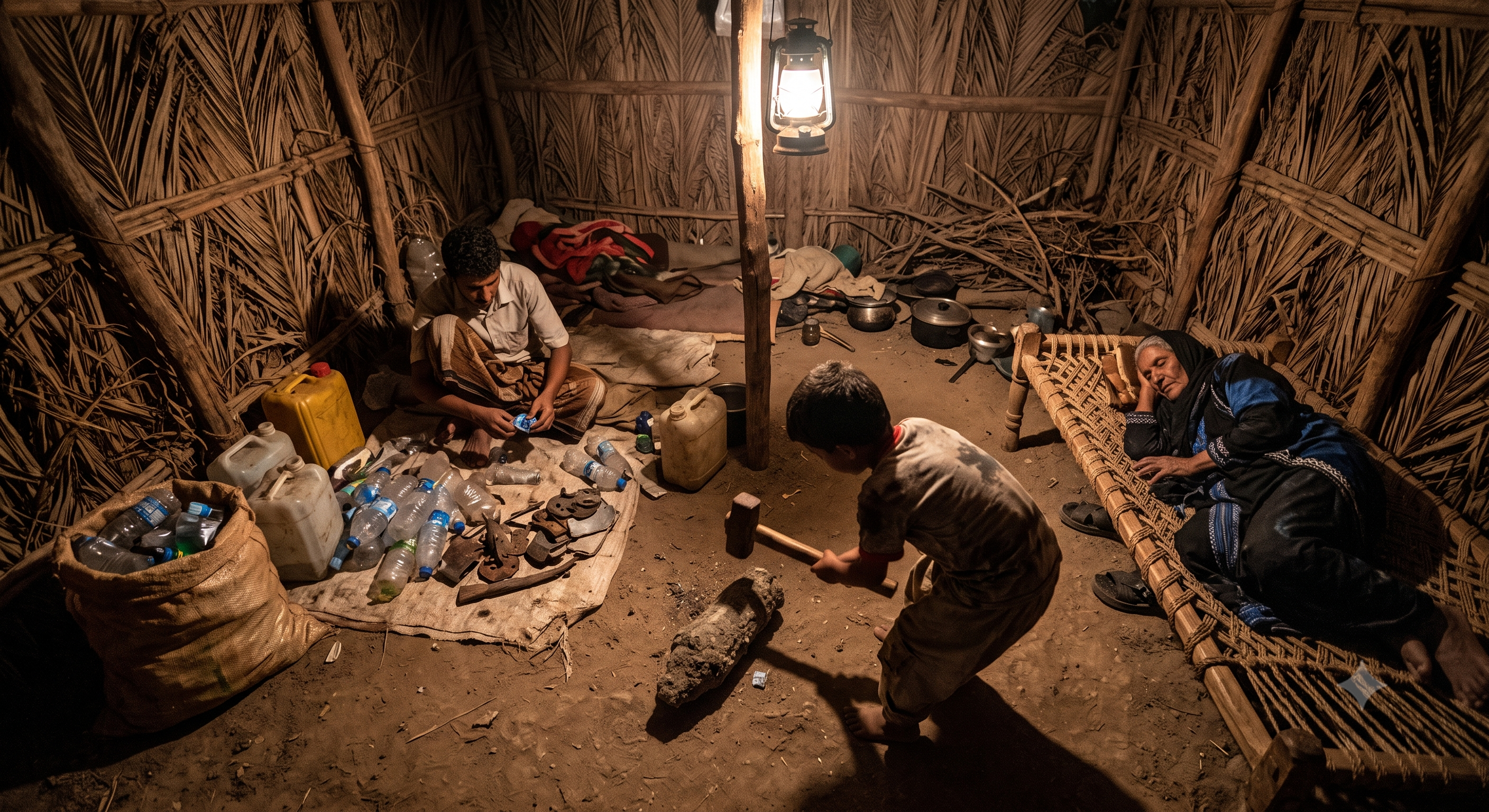
A Yemeni woman was killed, and a child and a man were seriously injured when an explosive remnant of war detonated in a remote area of Al-Hudaydah Governorate, western Yemen. The incident is a renewed reminder of the devastating human toll that explosive remnants of war continue to inflict on civilians and other vulnerable groups in former front-line areas.
According to eyewitnesses, the child, Omar Ahmed Masawi, found a military projectile in an open area known locally as Al-Khabt, outside the city, and took it to his family’s home. While attempting to remove metal wires from the projectile for sale, as part of the family’s efforts to earn a living by collecting scrap metal and empty plastic bottles, the device exploded inside the house.
The blast, which shook the residential neighbourhood, killed Umm Hashim Misk Mohammed Jassar and critically injured the child and his uncle, Abu Al-Ghaith Masawi. Both were transferred to the intensive care unit of a hospital in Al-Hudaydah City, where they remain in critical condition.
This tragedy is the latest in a series of similar incidents reported in Al-Hudaydah and other conflict-affected governorates across Yemen. Landmines, unexploded ordnance, and other explosive remnants of war have caused thousands of civilian casualties, including deaths and injuries, with children, women, and low-income workers among those disproportionately affected.
Despite ongoing, clearance efforts, including those undertaken through field-based initiatives such as the Masam Project, which has reported clearing more than 576,000 explosive devices and items of unexploded ordnance since the start of its operations, the vast extent of contaminated areas, the absence of minefield maps, and widespread poverty that compels many people to collect scrap metal continue to expose civilians to persistent and life-threatening risks in their daily lives.
In a statement issued on 29 July 2026, the American Center for Justice (ACJ) called for the development and launch of a broad national programme on explosive ordnance risk education. The programme should be built around comprehensive and sustained awareness campaigns that reach local communities in rural and conflict-affected areas contaminated by explosive hazards. It should prioritise groups at heightened risk, particularly children and workers in the waste-management and scrap-collection sectors, and enable them to recognise suspicious objects, understand appropriate safety measures, and report such objects promptly without approaching or handling them.
ACJ also urged all parties to the conflict, the international community, and relevant United Nations bodies to agree on and implement a comprehensive, adequately funded programme for surveying and clearing land contaminated by landmines, unexploded ordnance, and other explosive remnants of war. The Centre called for all parties to provide relevant minefield and contamination maps and for technical clearance teams to be equipped with modern technologies to support the clearance and protection of agricultural land and residential areas. It further called for sustained support for existing field initiatives and programmes and for the removal of obstacles that restrict their operational reach.
The Centre emphasised that relevant authorities and international humanitarian organisations must fulfil their ethical and legal responsibilities by ensuring the provision of immediate, high-quality medical care to victims. It also called for the establishment of fair and sustainable compensation mechanisms for survivors and affected families, together with long-term programmes providing psychosocial support and physical rehabilitation to those harmed by such explosions.
Statement on Explosive Remnants of War and the Risks They Pose to Vulnerable Groups
The American Center for Justice (ACJ) follows with profound sorrow and deep concern the tragic incident in Al-Hudaydah Governorate, which claimed the life of a woman and left a child and a man fighting for their lives in intensive care following the explosion of an explosive remnant of war.
This incident is a stark illustration of the grave and persistent dangers that continue to threaten civilians in the ordinary course of their daily lives and in their arduous efforts to secure their basic means of survival.
The American Center for Justice affirms that the rights to life, physical integrity, and personal security are fundamental and inherent rights protected under international human rights law, including the Universal Declaration of Human Rights and the International Covenant on Civil and Political Rights. These rights are further reinforced by customary international humanitarian law, which requires the protection of civilians from the immediate and long-term effects of armed conflict.
The continued presence of weapons, projectiles, landmines, and other explosive remnants of war in areas where civilians live, work, and graze their livestock constitutes a continuing threat to civilian safety and physical integrity, leaving entire communities exposed to delayed and indiscriminate dangers long after active hostilities have ceased.
Persistent poverty and deprivation, compounded by severe economic conditions, compel children and other civilians to approach hazardous objects without fully understanding the risks they pose. As a result, the remnants of war become instruments of continuing death and injury, affecting women, children, and other civilians within their homes and communities.
Accordingly, the American Center for Justice underscores the urgent need to develop and launch a broad national programme on explosive ordnance risk education. Such a programme should be based on comprehensive and sustained awareness campaigns capable of reaching local communities in rural and conflict-affected areas contaminated by explosive hazards. It must prioritise groups at heightened risk, particularly children and workers in the waste-management and scrap-collection sectors, and equip them to recognise suspicious objects, understand and adopt safe behaviour, and report such objects promptly without approaching, touching, or handling them.
In the same context, ACJ calls on all parties to the conflict, the international community, and relevant United Nations bodies to agree on and implement a comprehensive, adequately funded programme for surveying and clearing land contaminated by landmines, unexploded ordnance, and other explosive remnants of war. This should include requiring all parties to provide relevant minefield and contamination maps and equipping technical clearance teams with modern technologies to support the effective clearance and protection of agricultural land and residential areas. Existing field initiatives and programmes must also receive sustained support, and obstacles that restrict their operational scope and reach must be removed.
ACJ further emphasises that relevant authorities and international humanitarian organisations must fulfil their ethical and legal responsibilities by ensuring immediate access to high-quality medical care for victims; establishing fair, effective, and sustainable compensation mechanisms for survivors and affected families; and providing long-term programmes for psychosocial support, physical rehabilitation, and social reintegration for those harmed by such explosions.
Issued by the American Center for Justice (ACJ)
29 July 2026

Leave a Reply