
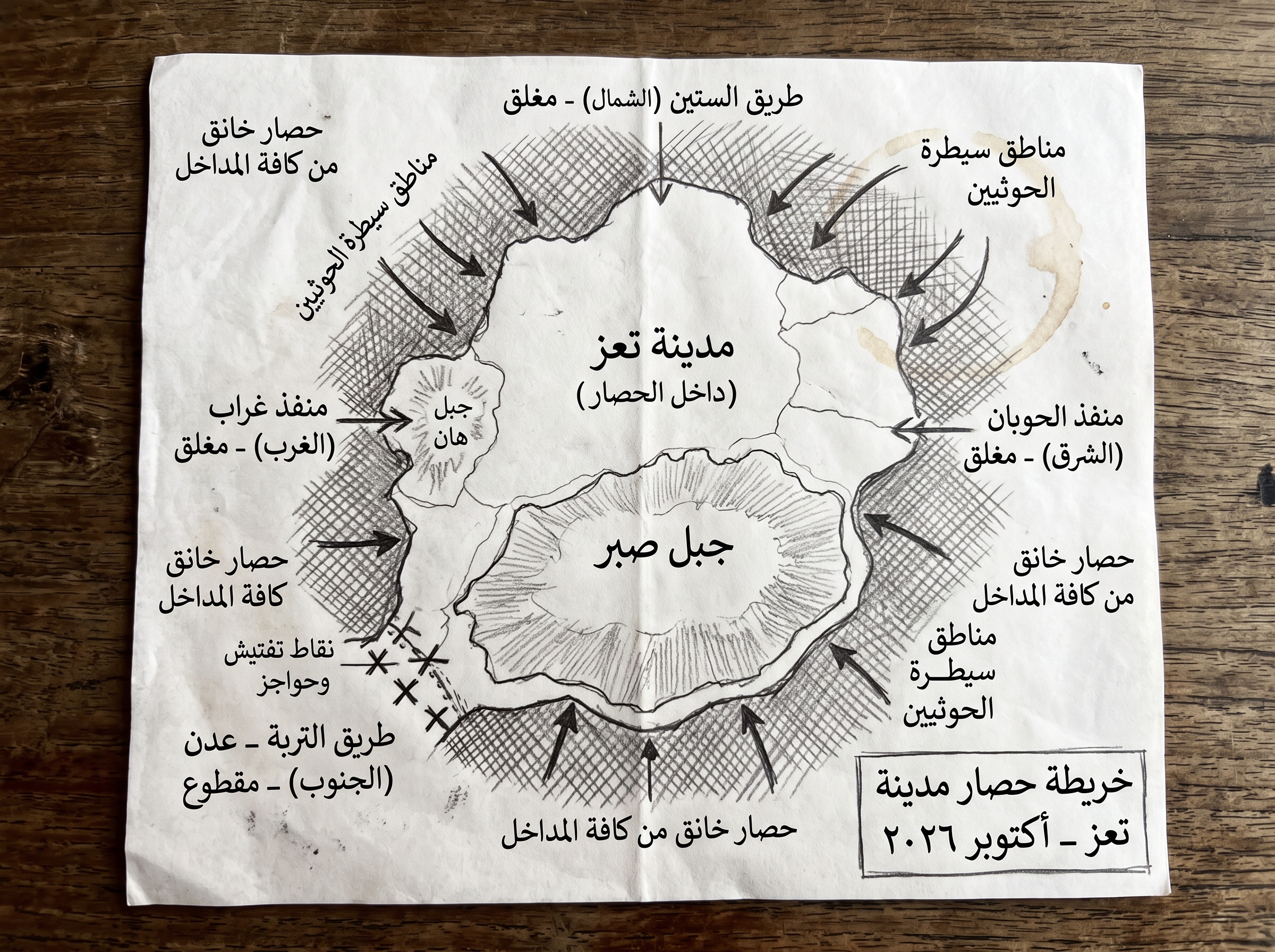
The city of Taiz, home to approximately 4.35 million people, alongside a large displaced population, is facing a genuine crisis of survival following the Houthi militia’s imposition of a complete siege on the city three days ago. The siege was tightened following a military escalation in which the militia seized strategic positions controlling key roads in the southern and eastern rural areas and along the western coast. These fronts have now joined the northern and western access routes, which had already been closed, completely severing the city’s connection with its surrounding areas. This military blockade is halting the flow of food, medicine, and fuel, pushing the healthcare system to the brink of imminent collapse.
Official warnings issued by the Ministry of Health indicate that the city’s hospitals are on the verge of running out of medicines, medical solutions, supplies, and fuel. These warnings have raised grave concerns that emergency services, surgical operations, intensive care units, dialysis centers, and neonatal incubators may cease to function. The siege places the lives of patients, the wounded, pregnant women, and newborns in immediate danger. It also demonstrates the Houthi militia’s deliberate use of starvation of civilians and the deprivation of objects indispensable to their survival as weapons of war, constituting collective punishment in violation of the peremptory norms of international humanitarian law.
Comprehensive political approaches have proved incapable of averting this catastrophe. The current situation demands a practical shift in the international response to this systematic strangulation, beginning with compelling the Houthi militia to open roads and access routes immediately, guaranteeing the free movement of civilians and the unimpeded passage of goods and humanitarian assistance, and holding the militia legally and morally accountable for the consequences of the blockade. This situation places the Office of the UN Special Envoy under a direct responsibility to move beyond waiting for comprehensive, long-term political settlements and instead initiate urgent mediation efforts focused on specific, limited issues. This approach would separate the humanitarian track from military complexities and battlefield gains, facilitate limited-scope agreements to open safe corridors and save lives immediately, and create opportunities for confidence-building that could pave the way for broader solutions.
This emergency situation calls for effective intervention by the United Nations, humanitarian organizations, and health partners to deliver medicines, oxygen, and fuel to healthcare facilities in coordination with the relevant authorities, and to activate a government emergency plan to ensure the continued operation of hospitals and water networks. This must be accompanied by serious action by the Office of the United Nations High Commissioner for Human Rights and the relevant international mechanisms to monitor and document the crime of imposing a siege and starving civilians, and to establish responsibility precisely, ensuring that those responsible for these grave violations do not escape accountability.
Issued by: American Center for Justice (ACJ)
Date: October 11, 2026

Leave a Reply